If you have been hunting for a roof painting contractor that Gulf Shores homeowners actually trust, you have probably hit a bigger question first: will roof paint even hold up here? Fair thing to wonder.
The problems this coast creates are different from anything a contractor in Birmingham or Nashville deals with. Salt air, punishing UV, and humidity that rarely lets up make this stretch of the Gulf one of the toughest environments for any coating to survive. That does not mean roof painting fails here. It means it has to be done right.
Key Takeaways:

Why Roof Painting Problems on the Coast Are Unique
Not every coastal environment is the same, and the Gulf Coast brings its own set of challenges. Gulf Shores, Orange Beach, and Foley sit where high humidity, salt-laden air, and intense summer sun combine year-round. Ocean breezes carry salt mist well inland, humidity slows how fast a roof dries after rain, and storm cycles stack salt exposure on top of heavy rain.
For a coating, that mix is relentless. Salt in ocean spray is hygroscopic, so it pulls moisture and holds it against the surface even on sunny days. Paint that should last 7 to 10 years can start fading or peeling in as little as 3 to 5 years near the coast, and a roof takes that punishment from directly overhead. These are not reasons to skip roof painting; they are reasons to get it right.
The 5 Most Common Roof Painting Problems in Coastal Alabama
Nearly every coastal roof coating failure comes back to one of these five causes.
1. Adhesion Failure Caused by Surface Moisture
This is the most common cause of early roof coating failure on the Gulf Coast, and it almost always traces to application conditions. Moisture trapped under the film builds vapor pressure that drives blistering and adhesion loss.
In Gulf Shores or Orange Beach, where morning dew can linger past 9 a.m. and afternoon humidity often sits above 80%, the safe window is narrow. Most acrylics need roughly 50°F to 95°F and below 90% relative humidity, and painting outside that invites failure. A contractor who ignores those conditions to hit a deadline is setting the coating up to peel within a year or two.
2. Skipped or Inadequate Surface Prep
Skip or shortcut surface prep and the coating cannot bond, which shows up as peeling, bubbling, and eventually water intrusion.
On a coastal roof, clean means removing salt deposits, algae and mildew, oxidation, and chalking from old coatings. Any dirt, moisture, or leftover contaminant compromises adhesion. That is why a thorough soft wash or pressure wash before any product goes down is where the job actually starts, not an optional add-on. Ed Wade Painting builds that wash into every roof coating job to strip the salt and biological buildup that would otherwise cause early failure.
3. Wrong Product for a Coastal Climate
Not every coating on a store shelf is built for the air around Mobile Bay and the Gulf. Products labeled for coastal use carry additives that stand up to salt spray and sun; general-purpose products do not.
Use a standard coating in salt air and you usually get premature chalking, UV brittleness, or blistering as moisture pushes through an under-engineered film. The same product logic runs through all exterior work, which our guide on oil vs latex exterior paint breaks down. Ed Wade Painting has been the paint vendor for major Gulf Coast properties like Beach Club and TradeWinds, clients who do not tolerate a coating that fails in a season, and that same standard applies to every home.
4. Thickness Errors During Application
Coatings have to go on at the manufacturer’s specified thickness and within the right temperature and humidity range. Too thin and the film cannot resist wear; too thick and it can wrinkle or trap solvent, which weakens it.
The coastal version of this is contractors spreading coatings too thin to stretch material or finish faster. A film below its target dry-mil thickness breaks down under UV and salt well before its rated life. This is why professional application with the right equipment, not a hardware-store roller, matters on every coastal roof.
5. Overlooked Seams, Flashing, and Penetrations
A well-coated field still leaks if the seams, fasteners, flashing, and penetrations were overlooked. Reinforcement fabric belongs where it is needed, detail coats go on the tricky spots, and every penetration gets inspected.
In a storm-active area, those details turn into failure points fast. A roof that looks solid across the middle but was never sealed around HVAC curbs, vents, or flashing edges will let water in exactly where you do not want it. Most coastal roof failures that end in water damage trace back to these details, not the coating itself.
When Roof Painting Done Right Actually Works
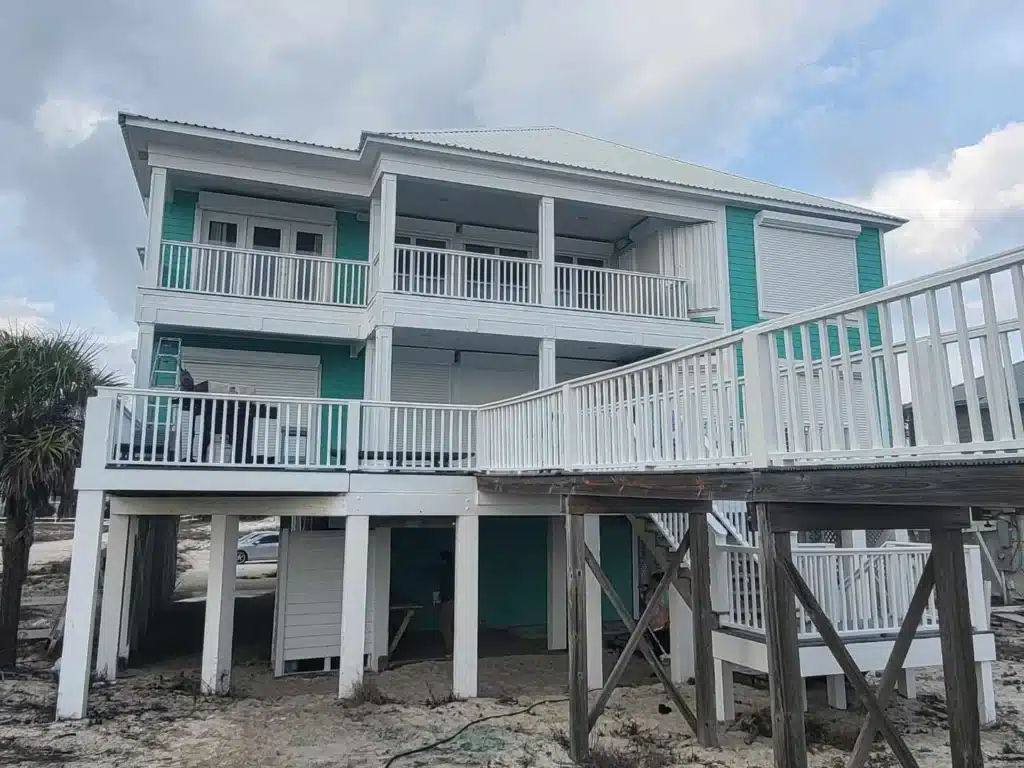
Here is the other side of all those problems: done correctly in a coastal climate, roof coating performs very well. A quality elastomeric coating forms a seamless waterproof membrane, reflects sun, and can add 10 to 15 years of roof life, sometimes more.
For homeowners running AC around the clock all summer, the energy side matters. Per cool roof data from the American Coatings Association, which cites the U.S. Department of Energy, reflective elastomeric coatings can cut a building’s annual air-conditioning energy use by up to 25%. Think of a reflective coating as sunscreen for the roof.
Elastomeric coatings also flex, expanding and contracting with temperature swings instead of cracking. That matters where afternoons push past 90°F and winter nights drop hard. Ed Wade Painting has applied wind and hurricane-resistant elastomeric coatings across Baldwin County since 2011, backed by a manufacturer product warranty and its own 5-year workmanship warranty.
How to Avoid Roof Painting Problems in Coastal Alabama
A coating that lasts in this climate is not complicated, but it demands a few things done right:
For how coating costs work here, see our guide on what affects exterior painting cost, since roof coatings are priced differently than wall work. And if trim or siding is failing alongside the roof, our post on common exterior trim paint problems covers the overlap.
Work With a Contractor Who Has Seen These Problems Up Close
Roof coating problems on this coast are not rare; they show up whenever the wrong product, wrong timing, or wrong prep meets the assumption that a paint job is the same everywhere. It is not. The air is saltier, the UV is stronger, and the humidity makes every application decision matter more.
Ed Wade Painting has applied elastomeric and hurricane-resistant roof coatings across Gulf Shores, Orange Beach, Foley, and the rest of Baldwin County since 2011. The team is licensed, insured, bonded, and workers-comp covered, and the work carries a 5-year workmanship warranty. The same care that made Ed Wade the paint vendor of record for major Gulf Coast resorts goes into every residential roof.
Want to know if your roof is a good candidate for a protective coating, with an honest answer on cost and lifespan? Contact Ed Wade Painting at 251-336-6477 to schedule a free consultation.